

Choosing a Hawaiian island can feel overwhelming when every destination looks perfect. With limited vacation time and a real budget, you don’t want to choose somewhere that means too much driving, too little variety, or the wrong atmosphere.
This guide compares the best Hawaiian islands to visit by travel style, transport and suggested stay length, helping you choose the right island for your interests without overcomplicating your trip.
Quick Island Comparison
| Island | Best Fit | Main Tradeoff | Suggested Stay |
|---|---|---|---|
| Oahu | First visits, dining and city–beach variety | Traffic and a busier urban setting | 5–7 nights |
| Maui | Beaches, resorts and couples | Major sightseeing trips can involve long drives | 5–7 nights |
| Kauai | Scenery, hiking and photography | Weather and access affect outdoor plans | 5–7 nights |
| Hawaii Island | Volcanoes and varied landscapes | Long distances between regions | 6–8 nights |
| Lanai | A quieter resort retreat | Limited accommodation and transport choices | 2–4 nights |
| Molokai | A slower, rural vacation | Fewer conventional visitor services | 3–5 nights |
These are the six major visitor islands identified by Hawaii’s official tourism site. Suggested stays are editorial recommendations for a relaxed trip, rather than minimum requirements.
Oahu for First Visits
Oahu is a practical starting point for travelers who want several kinds of vacation in one place. Honolulu and Waikiki provide an urban base, while beaches, the North Shore and historic attractions offer reasons to explore beyond it.
It works particularly well for groups with different interests. One person can prioritize restaurants and shopping while another plans beach days or visits to Pearl Harbor and Diamond Head.
Your accommodation location makes a substantial difference. Waikiki puts restaurants, beaches and transport close together. Staying elsewhere on Oahu may offer a quieter setting but can increase the need to drive.
A Waikiki-based vacation can work without renting a car every day. Public buses, shuttles, taxis and organized tours provide alternatives, although distant stops still require careful route planning.
Choose Oahu when convenience and variety matter most. For a vacation centered on a secluded setting, compare the specific accommodation area carefully.
Maui for Beach Vacations
Maui suits travelers who want beach and resort time with a few substantial outings. South Maui includes Kihei and Wailea, while West Maui includes the Kaanapali area. Haleakala and the Road to Hana provide contrasting scenery beyond the coast.
The key decision is how much sightseeing you want around your beach days. A coastal hotel may be ideal for relaxing but still involve a lengthy journey to another region.
For families, compare accommodation near the activities you expect to use regularly. For couples, decide whether the priority is resort time, scenic drives or a mixture. A comfortable base with fewer major driving days often works better than an ambitious island circuit.
Kahului is Maui’s main airport, and a rental car is useful for independent exploration. Plan your larger outings before choosing where to stay, especially if Haleakala or Hana is central to the trip.
Check current access before including Lahaina in your itinerary. Recovery areas have different entry conditions, and older guides may not reflect present access.
Kauai for Scenery
Choose Kauai when the landscape is the main reason for traveling. The Napali Coast, Waimea Canyon and Hanalei area offer different experiences within one island vacation. You can organize your days around viewpoints and shorter outings as well as more demanding hikes.
Where you stay matters. A North Shore base serves a different set of outings from Poipu on the South Shore. Choose accommodation near your main interests rather than assuming every region will be equally convenient.
Lihue is the main airport, and a rental car is recommended for exploring. Allow flexibility in the schedule so a weather-dependent outing can move without disrupting the entire vacation.
Kauai is a good fit for travelers who enjoy spending time outdoors without needing a different organized attraction every day. Check trail conditions and state park notices before setting out, particularly after severe weather.
Hawaii Island for Volcanoes
Hawaii Island, also called the Big Island, is separate from Oahu. It suits travelers interested in volcanic terrain, coastal scenery and exploring distinct regions. Hawaii Volcanoes National Park is one of its main attractions.
The island’s size changes how you should plan. Kona and the Kohala Coast are common bases for coastal and resort time. Hilo and the Volcano area serve another part of the trip.
For a longer vacation, splitting your stay can reduce repeated cross-island drives. Official travel guidance also suggests considering arrival on one side and departure from the other, depending on flights and rental-car return charges.
With less time, choose fewer regions. A vacation focused on one side of the island can be more enjoyable than spending every day covering long distances.
Visible lava is not guaranteed. Eruptions can pause, and weather can prevent viewing. Check current National Park Service and USGS information before visiting, and use designated viewpoints.
Lanai for Quiet Retreats
Lanai is worth considering when you want a smaller destination and a vacation organized around a quieter stay. Its attractions include Hulopoe Bay, Lanai City and the landscape at Keahiakawelo.
Arrange accommodation and transport together. Confirm what your lodging provides, how you will arrive and how you will reach the places you want to explore. Transfers, taxis and rental vehicles need advance planning because supply is limited.
Lanai can work as a short addition to Maui, but a day trip and an overnight stay serve different purposes. Visit for the day when you have a specific outing in mind. Stay longer when the accommodation experience and slower pace are the main attractions.
Molokai for Slower Travel
Molokai suits travelers who prefer a simpler, rural vacation. Accommodation includes a hotel, condos, cottages and bed-and-breakfast options. A rental car is useful, and limited vehicle supply makes early arrangements sensible.
Choose it when a relaxed pace is part of the attraction. Travelers who want extensive resort facilities and a busy schedule of interchangeable tours may find Oahu or Maui a better fit.
Do not assume a Kalaupapa visit will be available. Access is restricted, and the National Park Service operating information checked for this guide states that no active permitted tour operator or tours are available. NPS identifies the Kalaupapa Overlook at Palaau State Park as an alternative, subject to local access conditions.
Respect private land and local guidance, and plan around the services available rather than expecting the infrastructure of a larger visitor destination.
Resolve Your Shortlist
Oahu or Maui
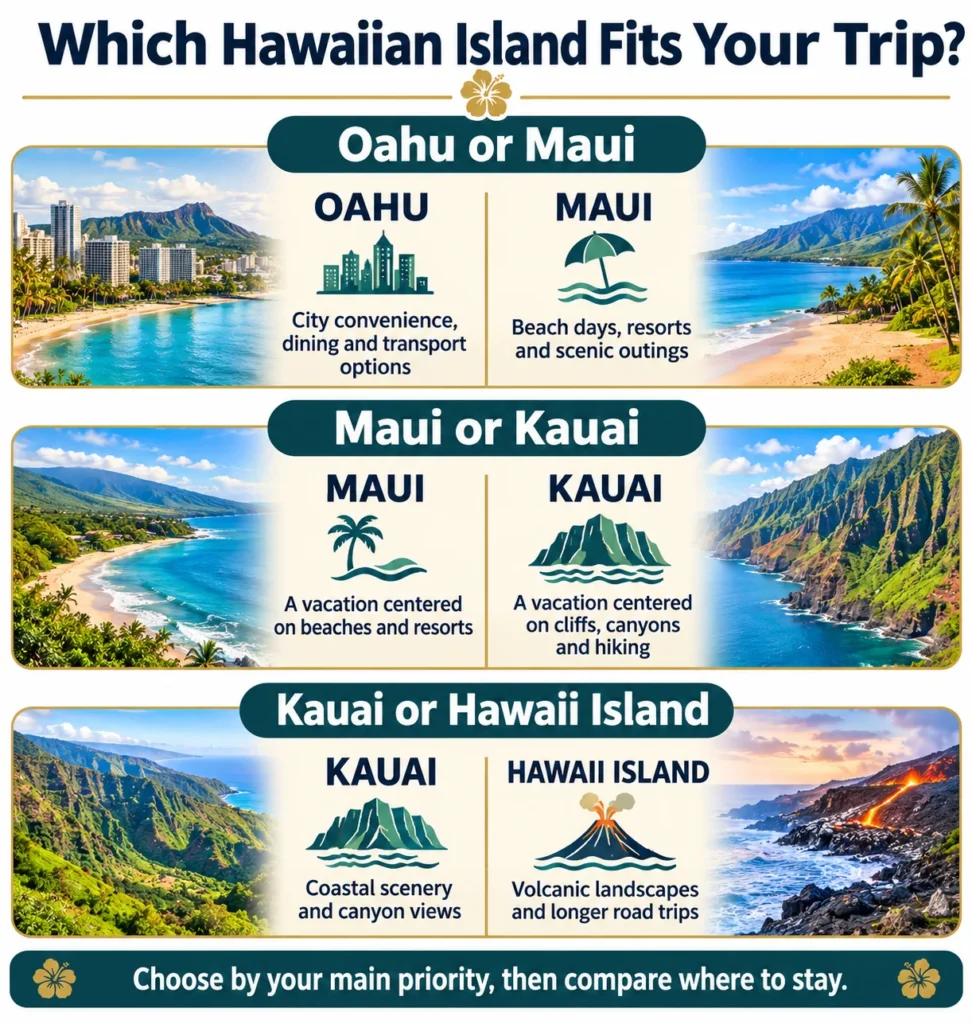
Choose Oahu for city convenience, dining variety and a Waikiki-based vacation with alternatives to driving. Choose Maui when beach and resort time should occupy most of the schedule.
For families, compare the actual accommodation and daily travel distances. A suitable base can matter more than a broad island ranking.
Maui or Kauai
Choose Maui when beaches and resort time lead the plan. Choose Kauai when coastal and canyon scenery are the main reason for going.
Both can support an active or relaxed vacation. The distinction is which experience you want to build your days around.
Kauai or Hawaii Island
Choose Kauai for the Napali Coast and canyon scenery. Choose Hawaii Island for volcanic landscapes and a journey through different regions.
Hawaii Island benefits from additional time to manage distances. Kauai benefits from flexibility around outdoor conditions.
Airports and Transport
| Island | Main Airport | Practical Approach |
|---|---|---|
| Oahu | Honolulu — HNL | Transit and tours can work from Waikiki |
| Maui | Kahului — OGG | Car useful for independent sightseeing |
| Kauai | Lihue — LIH | Car recommended for exploring |
| Hawaii Island | Kona — KOA; Hilo — ITO | Match your airport and accommodation bases |
| Lanai | Lanai — LNY | Arrange connections and transfers ahead |
| Molokai | Molokai — MKK | Reserve connections and a vehicle ahead |
Check current airline connections, particularly for smaller airports. Accommodation location and planned activities should guide your transport choice.
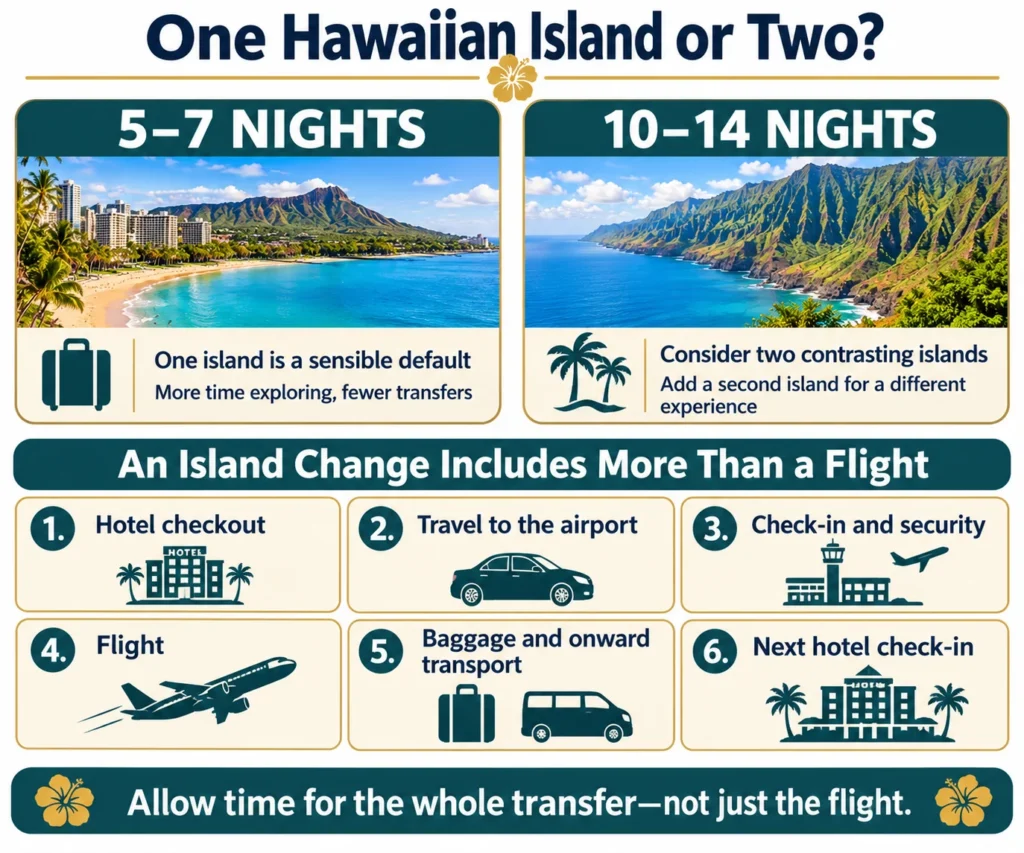
When changing islands, include the entire transfer process in your itinerary. Hotel checkout, airport travel, security, baggage and another transfer can consume a substantial part of the day even when the flight itself is short.
One Island or Two
For five to seven nights, one island is a sensible default. You can settle into a base and spend more time at the places you enjoy.
For ten to fourteen nights, consider two islands with a clear contrast:
- Oahu and Kauai: urban convenience followed by scenery-focused days.
- Maui and Hawaii Island: beach time followed by volcanic landscapes.
- Maui and Lanai: a main-island vacation with a quieter addition.
These are itinerary suggestions, not guarantees of convenient connections on your dates. Check transport before booking accommodation.
Add another island when it brings an experience you genuinely want. If it mainly adds similar beach days, staying longer on your first island may offer better value.
Budget and Timing
Compare Complete Costs
Oahu is a useful starting point for a budget comparison if staying in Waikiki lets you avoid renting a car every day. It is not automatically the cheapest choice for every traveler.
Compare flights, accommodation, taxes, mandatory charges, transport, parking, meals and activities using the same dates and cancellation terms.
Smaller islands are not necessarily cheaper. Limited accommodation or transport choices can change the total, while additional island transfers introduce more costs.
Choose Dates by Activity
Hawaii’s weather varies by coast and elevation as well as season. The official weather guide identifies November through March as the wettest months, while emphasizing that conditions are localized. Choose your base and activities together rather than expecting one island to guarantee sunshine.
For Maui whale watching, official guidance lists December through May as the season, with January through early April as the peak period. Winter also brings large surf to Maui’s North Shore, so check local conditions when planning beach activities.
Reservations to Check
Some popular attractions need advance planning:
| Attraction | Island | Reservation Requirement |
|---|---|---|
| Diamond Head | Oahu | Nonresident entry and parking reservations |
| Haena State Park | Kauai | Visitor reservations, with different transport options |
| Haleakala Sunrise | Maui | Summit entry reservation between 3 a.m. and 7 a.m. |
| Waianapanapa | Maui | Advance nonresident entry and parking arrangements |
For Haena, hiking beyond Hanakapiai Valley along the Kalalau Trail requires a camping permit, even for a day hike. Haleakala’s sunrise reservation is separate from the park entrance fee. Read the relevant conditions rather than assuming one reservation covers everything.
Check current operating notices too. A reservation does not override a closure or a change in access.
Common Questions
Must I Connect Through Honolulu?
No. Depending on your departure city and schedule, direct flights may be available to Maui, Kauai or Hawaii Island. Smaller islands require more attention to connections. Compare complete journeys before choosing an arrival airport.
Can I Travel by Ferry?
A passenger ferry connects Maui and Lanai. Expeditions currently lists service between Maalaea Harbor and Manele Harbor, taking approximately 70 minutes. Confirm current departures and onward transport before booking; do not assume ferry connections exist between every island.
Are Short Island Visits Worthwhile?
They can be, especially when you have one specific experience in mind. For a first vacation, avoid adding an island simply to increase the number visited. Judge the extra stop by what it adds after accounting for transfers, accommodation changes and cost.
